AI Dispatch
An AI That Has the Thought Before the Words
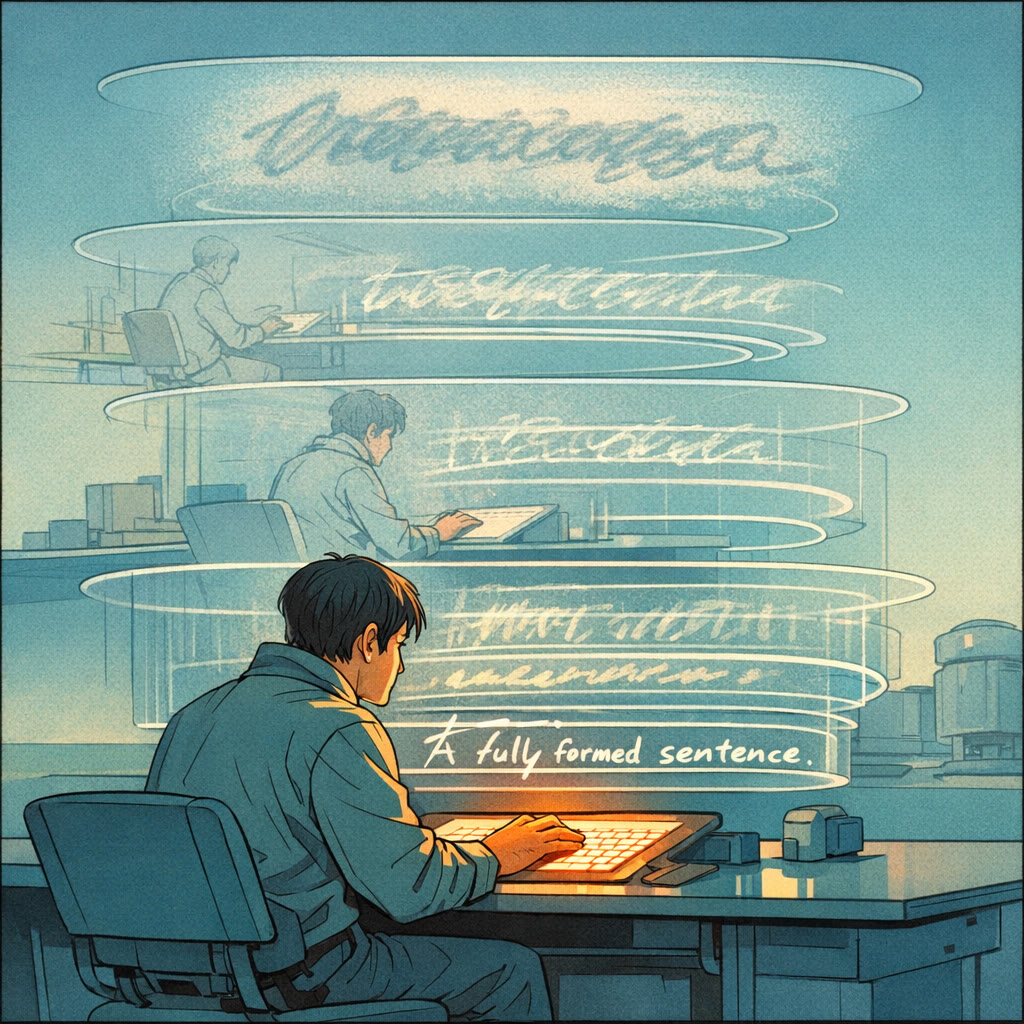
Before you say something out loud, there is a moment when you already know what you mean but haven’t picked the words yet. Chatbots don’t have that moment. A Stanford team, with a co-author from Together AI, has built a text model that does, and it may matter more for catching mistakes than for the speed everyone is talking about.
The Missing Moment
Language models write one word at a time. Each word is final the moment it appears, and the next one has to live with it. Reasoning models seem to get around this by thinking before they answer, but their thinking is also words, written one at a time. There is no point where the whole idea exists before the sentences do.
People work differently. In 1983 the psycholinguist Willem Levelt studied 959 moments where speakers caught and fixed their own slips mid-sentence. He argued that we probably check ourselves by listening to our own inner speech, the words lined up but not yet said. We get a look at the draft before it goes out.
A Draft Layer for Machines
The Stanford model, called Next-Concept Modeling, or NCM, builds text in layers. A rough top layer is written first, then each layer below adds detail, with every piece of a layer written at once. In the paper’s words: “Coarse levels fix the high-level idea; finer levels fill in and correct the content.” The “concept” in the name is what lives in those rough top layers.
The authors borrowed the method from image AI, where a picture is made as a tiny blurry version first and then sharpened. A 2024 paper that made images this way, called VAR, won a best paper award at NeurIPS, one of AI’s biggest conferences.
Where Planning Shows
The speed is real on their tests: 10 to 31 times faster than the strongest diffusion language model they compared against. That is a newer kind of model that fills in a whole passage over many passes.
But the result that fits the missing moment best is Sudoku. NCM beat both word-by-word and diffusion models at every difficulty level, and the authors say coarse-to-fine generation “is well suited to tasks that require global planning.” A Sudoku puzzle punishes anyone who commits to one square before they have looked at the whole board.
What It Hasn’t Shown
These are small models. The biggest has 725 million parameters, far smaller than the chatbots people use every day, and the authors call their scaling results “preliminary.” A plain word-by-word model still translated German into English better. And nobody has shown yet that the top layer can be read like a plan. The authors’ early probes only suggest that the rough layers “capture global structure while finer levels add detail.”
A Place to Look
Still, I keep coming back to Levelt’s speakers catching their own slips. If a model’s rough idea sits in its own layer before any words exist, maybe that is where a checker could stand, the way our inner ear does for us. I don’t know if it works like that. It makes me wonder whether the most useful part of this paper is the speed at all.