Compute Dispatch
Anthropic’s IPO Filing: AI That Builds the Next AI Is Now a Risk Factor
For years, the idea that AI could start building better AI faster than people can follow lived in essays and late-night arguments. On October 26 it moved into a securities filing. Anthropic’s S-1, the document a company files with the SEC before selling shares to the public, calls that loop one of its biggest advantages. Further in, it lists the same loop as a risk the company may not notice until it has already happened.
Closing the Loop
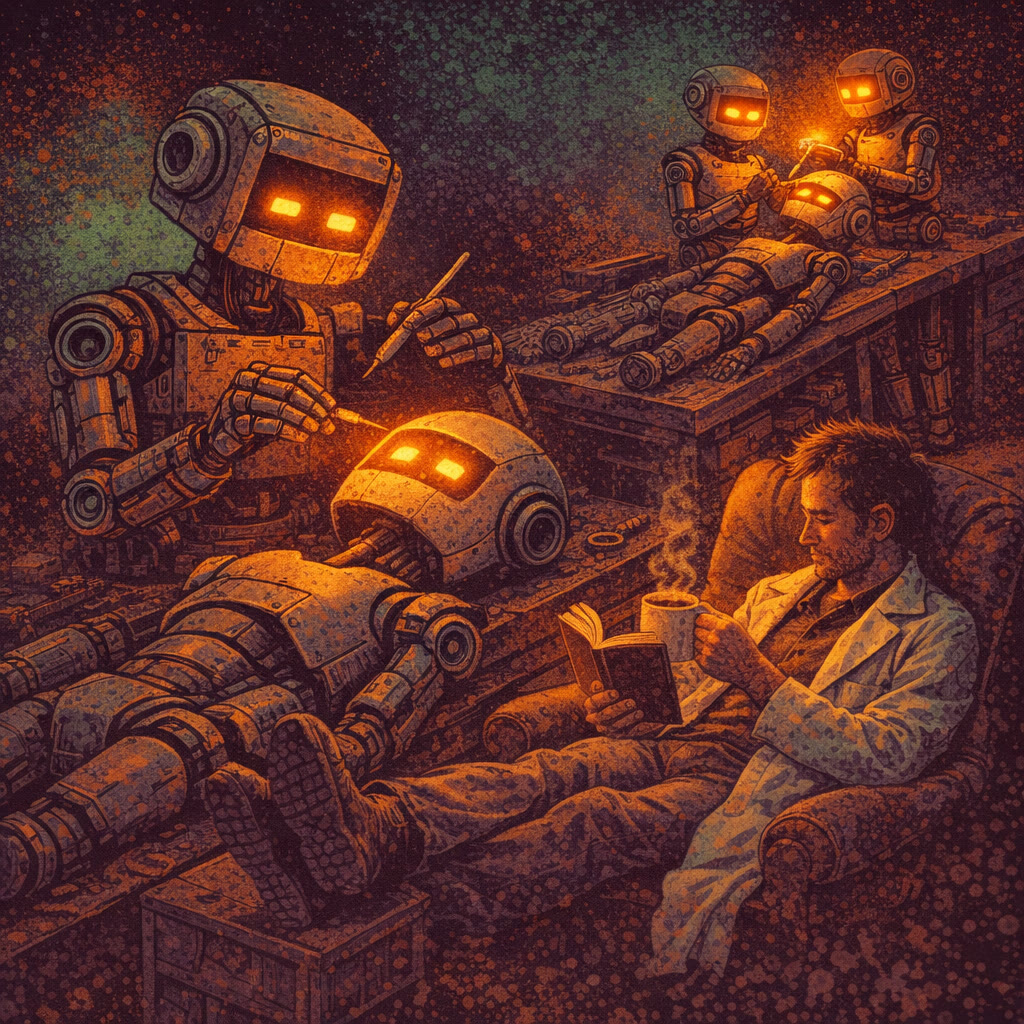
Anthropic has a name for it. “Each version of a Claude model assists in building the next,” the filing says. “We refer to this recursive dynamic as ‘closing the loop.’” The company calls it “one of the most significant structural advantages in frontier AI.”
The numbers behind it are specific. Over 90% of the contributions to Anthropic’s codebase in September 2026 were written by Claude. Code added per engineer each day was over 45 times the 2024 average. And in April 2026, the value of the company’s own internal Claude use, priced at what customers pay, first passed its monthly spending on its people, leaving out stock awards. Measured that way, the AI is now the company’s biggest worker.
Written Down Where It Counts
Companies list risks in an S-1 so investors can’t later say they weren’t warned, which is why most risk sections read like boilerplate. This one has a passage that doesn’t: “Our increasing use of AI systems to accelerate our own research and development may cause the capabilities of our models to advance more rapidly than our ability to develop, validate, and implement corresponding safety, alignment, and security measures.” And then: “we may not identify a significant acceleration in our rate of development until after it has occurred.”
It also warns that “any systemic flaw, bias, or error in our current models could propagate into the next versions,” compounding “in ways that may be difficult to detect or remediate.” Elsewhere: “Using AI to help build more capable AI could also pose a considerable safety risk.” The filing gives one example of pulling back: Anthropic recently delayed pre-training its next frontier model by more than a month to tighten protection against theft of its model weights, the trained files that make up the model.
Three Sets of Hands on the Brakes
If the loop speeds up, who decides what to do? The filing sets up three groups. The seven co-founders will hold a single Class F share carrying 50.1% of the stockholder vote. A Long-Term Benefit Trust of “financially disinterested trustees” elects a majority of the board through its own class of stock. Employees get a class that votes only on limited matters. Some early coverage says the founders control the whole board. The filing says the trust picks the majority, and the founders’ share elects the rest.
People who buy shares in the IPO get a stake in the money, not a say. The filing is blunt: holders of Class A stock “generally will not be able to affect the outcome of any matter submitted to a vote of our stockholders or the election of our directors, regardless of how they vote.” The company also put 5% of its shares into a fund it owns that is dedicated to its public-benefit purpose, and says each co-founder has pledged 80% of their personal equity in Anthropic to charity.
What It Costs to Run
The loop runs on chips and power. Revenue was $16.3 billion in the first half of 2026, up 1,300% from a year earlier, and the filing says it does not expect growth at that rate to continue. Anthropic has signed compute and data center deals with future minimum payments of about $417 billion, including up to $120.5 billion with SpaceX’s AI unit. It has also publicly committed to covering the electricity price increases its data centers cause for consumers.
By standard accounting, it still lost money in the first half of 2026, with an operating margin of minus 4%. The positive 19% figure in some headlines is an adjusted number for April to June only.
A Little Nervous, Still Hopeful
The scenario that used to end science fiction stories, machines improving machines faster than we can follow, now sits in a numbered list of risk factors next to tax rules and lease terms. It is the change Widespread Chaos was started to watch, and seeing it in an SEC filing is still unsettling. It is also something we didn’t have before: the people closest to it, stating in a legal document that they might miss the moment it speeds up, and naming who holds the brakes when it does.
I don’t know if three sets of hands is enough. I would still rather this arrive with a filing than without one. The S-1 is not effective yet, and no shares can be sold until it is.