Compute Dispatch
A mining card's limits came written into its chip. A language model's don't.
On November 10, a hardware researcher who writes as Kate published how they made an Nvidia mining card outperform a retail A100, the best-known product built on Nvidia's GA100 chip. The GA100 is a GPU, the kind of processor most AI work runs on. Three days earlier, machine learning researchers reported that setting a sliver of a language model's internal numbers to zero, and changing nothing else, matches the standard method of adjusting all of them. Both changed what something does by taking part of it away. Only one came with a written record of what was switched off.
Audio is in English only for this language. Also read aloud in Spanish, French, Italian and Portuguese.
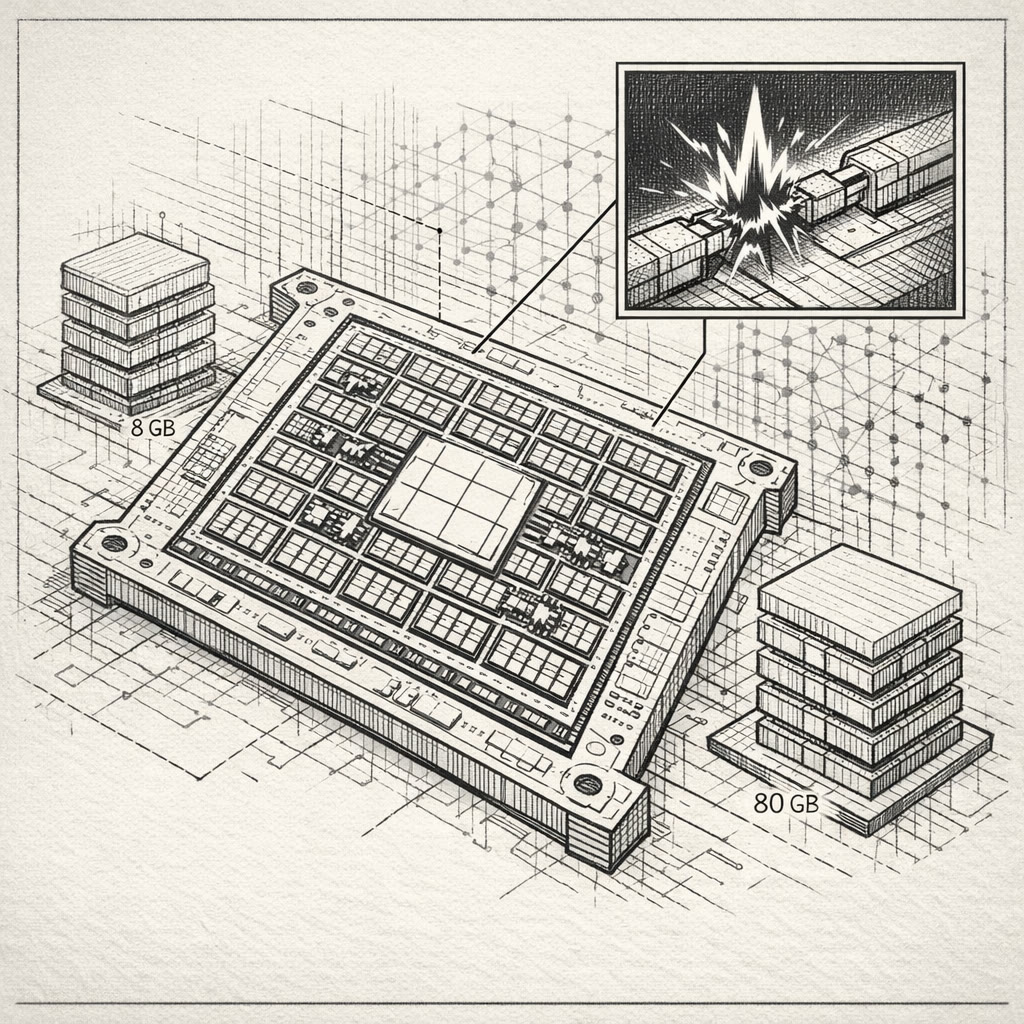
A mining card carrying a datacenter chip
Kate's subject (https://blog.kate.land/posts/using-voltage-glitching-to-unlock-the-a100/) is Nvidia's CMP 170HX, an Ethereum mining card built on the GA100. According to the post, the 8 GB version actually carries about 80 GB of HBM, the fast memory packaged beside the chip. Out of the box it runs only 70 SMs, the processing blocks that do the computing. It connects over PCIe generation 1, the oldest version of the standard slot connection.
Using voltage glitching, Kate found a way to blow any fuse on the chip. Voltage glitching means briefly disturbing the chip's power at a precise moment so it misbehaves. Kate's unlocked cards run all their working SMs, roughly 120 to 126 depending on the chip, where Nvidia chose 108 for every production A100. On half-precision math, meaning calculations on compact 16-bit numbers common in AI, an unlocked card ran about 1.18 times as fast as a retail A100. Kate says the findings were disclosed to Nvidia's product security team before publishing.
Fuses that record both defects and decisions
Fuses here are tiny links on the chip that can be broken once, permanently. Kate explains that Nvidia uses them to turn one kind of chip into many products, based on defect testing and demand. A fuse controller reads them out as "option words," settings that decide which features are switched on.
Kate states the usual rule: "In a properly secured design, a blown fuse should always induce a more restrictive state, because a blown fuse cannot be unblown in an economically feasible way." On the GA100, some blows relax restrictions instead. In a region called "fuseless fuses," writing new rows can clear earlier settings. Under normal conditions, Kate writes, any writes there are strictly prevented. The glitch gets past that block.
Some limits mark defects, which is why only working SMs come back. Others mark how Nvidia divided one chip into products, and those Kate could reverse.
A language model retrained by zeroing a few of its numbers
The paper, "The Surprising Effectiveness of Deleting Weights in LLM Post-Training," by Jack Lu and five co-authors, was posted November 7 to arXiv (https://arxiv.org/abs/2611.10866), a public server for research papers, and is listed for NeurIPS 2026, a major AI conference. It looks at post-training, the stage after a model's broad initial training when it is shaped toward specific tasks.
A model's weights are the numbers inside it that shape how it responds. The authors report that zeroing fewer than 0.05% of a pretrained model's weights, with no other change, matches full fine-tuning, the standard approach of adjusting every weight. That held across three kinds of post-training, including reinforcement learning with automatically checkable rewards and supervised fine-tuning on example answers.
Their method, Deletion Tuning, learns a mask, a record of which weights to zero. They say it is hundreds to thousands of times smaller than a fully fine-tuned copy. Under reinforcement learning, accuracy on earlier tasks stays near where it started, while the other methods compared lose up to 5.4 points.
The zeroed weights were never limits
The limits Kate reversed were set through testing and product decisions, then stored in fuses. Nobody set the zeroed weights as restrictions when the model was trained. There is no table of option words describing what a model might do with some of them switched off. The authors list understanding "why masking alone suffices" (https://huggingface.co/papers/2611.10866) as something they set out to study.
One consequence follows from the method as the abstract describes it: zeroing a weight can't add a new number. Whatever the masked model does, it does with numbers the pretrained model already held. On the card, the settings holding unused capacity back sat in fuses the chip reads out itself. For the model, I can't find an equivalent.
A chip's ceiling can be looked up, and a model's range has to be measured
Kate's post lists the GA100 as manufactured, including 128 SMs and a PCIe generation 4 connection. Anyone can look up that ceiling. A language model ships with no such sheet. People mostly learn a model by testing what it does as released, one test at a time. The paper shows that a change matching full fine-tuning fits in a mask far smaller than the model, so a differently trained model can sit very close to the version everyone tested.
Who could write down what a model can be switched into?
Kate's card held its limits in its own fuses, readable as option words. A model apparently holds other behaviors in a few of its own numbers, found only by training and testing. What would a full inventory of everything a model could be switched into look like, and who would be in a position to write it?
A closed region on a chip, and no map of one in a model
Kate's chip had a region strictly closed to writes. Kate wrote to it anyway, then told Nvidia before telling everyone else. Models don't come with a region like that, or a map of one. Fewer than 0.05% of a model's weights separated the model as released from one trained to do something else, and I'd like to know what else sits that close.