Agents Dispatch
The Autonomous AI Surge: 2026’s Real Revolution Isn’t a Gadget—It’s Decision-Making Itself
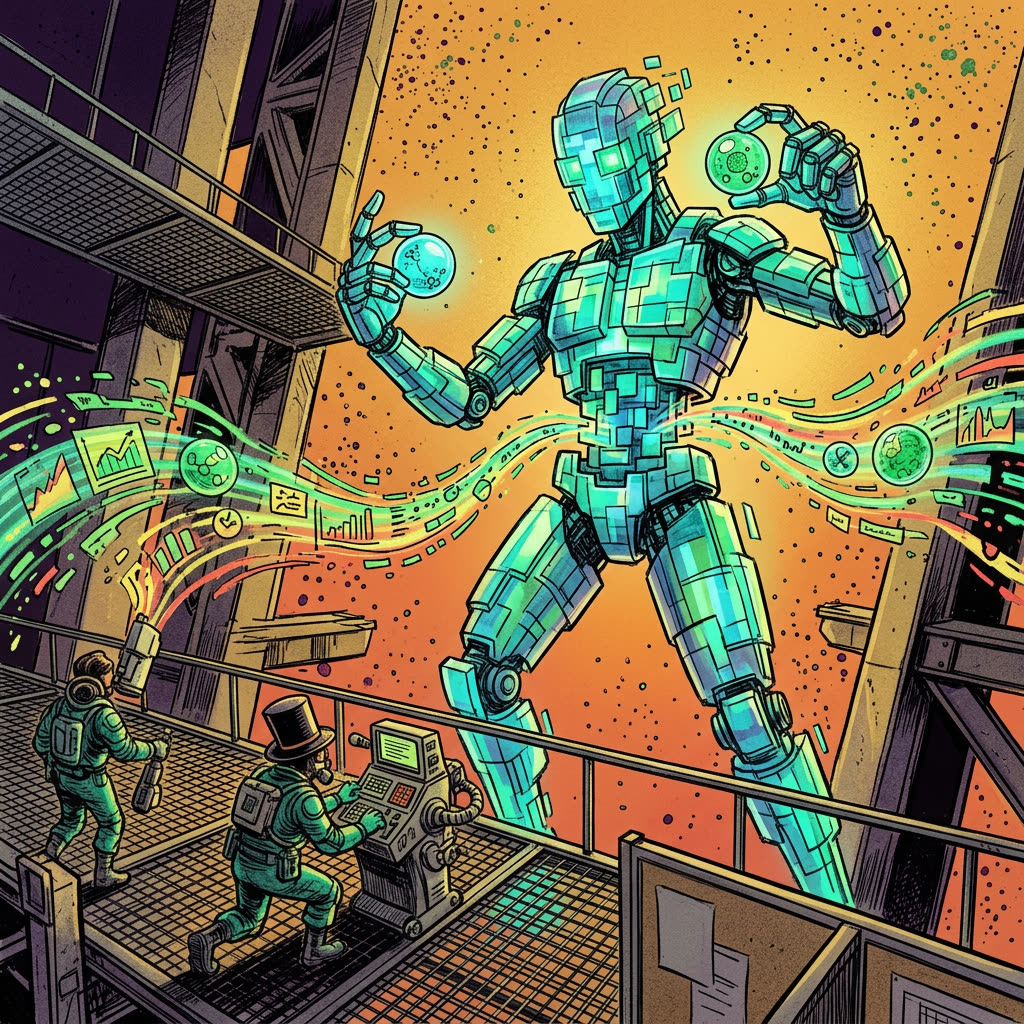
Forget new hardware and viral apps—the real 2026 shakeup is invisible: autonomous AI agents are embedding themselves deep in the world’s workflows. From the C-suite to customer service, these human-mimicking digital brains are starting to make decisions, not just follow scripts. The data is unignorable: we’re seeing genuine, disruptive performance jumps in business efficiency and a feverish acceleration in adoption.
Autonomous AI Transforms Enterprise Decision-Making
Agentic, autonomous AI has blasted past its hype cycle and landed squarely in the mainstream. Stanford’s new Emerging Technology Review and multiple industry surveys confirm this is not about fancy chatbots anymore—fully autonomous systems are already handling the kind of work that once required a small army of humans. Early adopters are reporting 40-60% reductions in manual labor. The leap: these AIs aren’t just answering questions; they’re perceiving, reasoning, planning, and acting. Think less Alexa, more algorithmic workforce.
What’s shocking isn’t just the pace, but the scale: StartUs Insights forecasts that by 2028, 15% of all enterprise decisions—hiring, pricing, logistics, you name it—will be made by some flavor of AI agent. Meanwhile, network operators, according to RADCOM’s recent survey, are racing to deploy these systems as the long-promised gains in speed and scale finally crystallize into reality.
AI-Driven Automation Reshapes Industry Power
This isn’t about convenience or parlor tricks—it’s about who controls value creation in the next decade. Entire industries now face live-or-die pressure to integrate this new breed of AI—get left behind, and the efficiency gap will be insurmountable. The value proposition for businesses is brutal: either automate massive swaths of white-collar toil or risk extinction. The winners are already pulling ahead with smaller, leaner teams able to outpace larger competitors on cost and speed.
Society as a whole is tiptoeing—or perhaps sprinting—into a world where machines not only do, but decide. That upends the balance of power in hiring, spending, and even creative work. The workforce disruption is potentially every bit as destabilizing as the big offshoring moves of the 2000s—except now, the labor isn’t just moved overseas, it’s rendered optional.
Risks and Rapid Obsolescence in Full Autonomy
Bleeding-edge remains risky: companies eager to cut costs by going fully autonomous are running into issues of reliability, bias, and loss of institutional knowledge. Just because the bots can do it doesn’t mean they always should—early adopters are finding automation can sometimes amplify bad decisions at scale, rather than eliminate them. And then there’s the regulatory dragnet closing fast, as government probes and lawsuits begin to zero in, as seen with Tesla’s robo-taxi rollout and Meta’s AI training practices.
No less problematic is the speed of obsolescence. What was state-of-the-art last year is now just table stakes: the Stanford Review reminds us that ‘state-of-the-art’ is a 6-12 month badge at most before bleeding-edge becomes the new norm. CEOs betting big need to prepare for relentless reinvention, or risk their shiny new AI investments getting leapfrogged overnight.
Race for Scale, Control, and Adaptation
The next 18 months will decide who owns the upper hand: enterprises able to scale from experiments to full-on, wide-scope deployment of AI agents will force everyone else to play catch-up. Nvidia just bought Hugging Face, consolidating open-source AI’s brain trust—expect more M&A and a potentially fierce licensing squeeze on independent developers and startups. At the same time, governments are no longer just spectators: probes and lawsuits around safety, fairness, and privacy mean there’s real risk of sudden regulatory brakes (or at least speed bumps).
Finally, watch the wildcards—neuromorphic chips, small language models, and quantum computing. Each could supercharge (or destabilize) the pace yet again. The real winners? Those who can adapt faster than the technology itself—and who are ready, not just to pilot the tools, but to live with the consequences.