Physical AI Dispatch
ScaleVLA's 552-Billion-Parameter Model Made Its Biggest Real-Robot Gain Where the Plug Meets the Socket
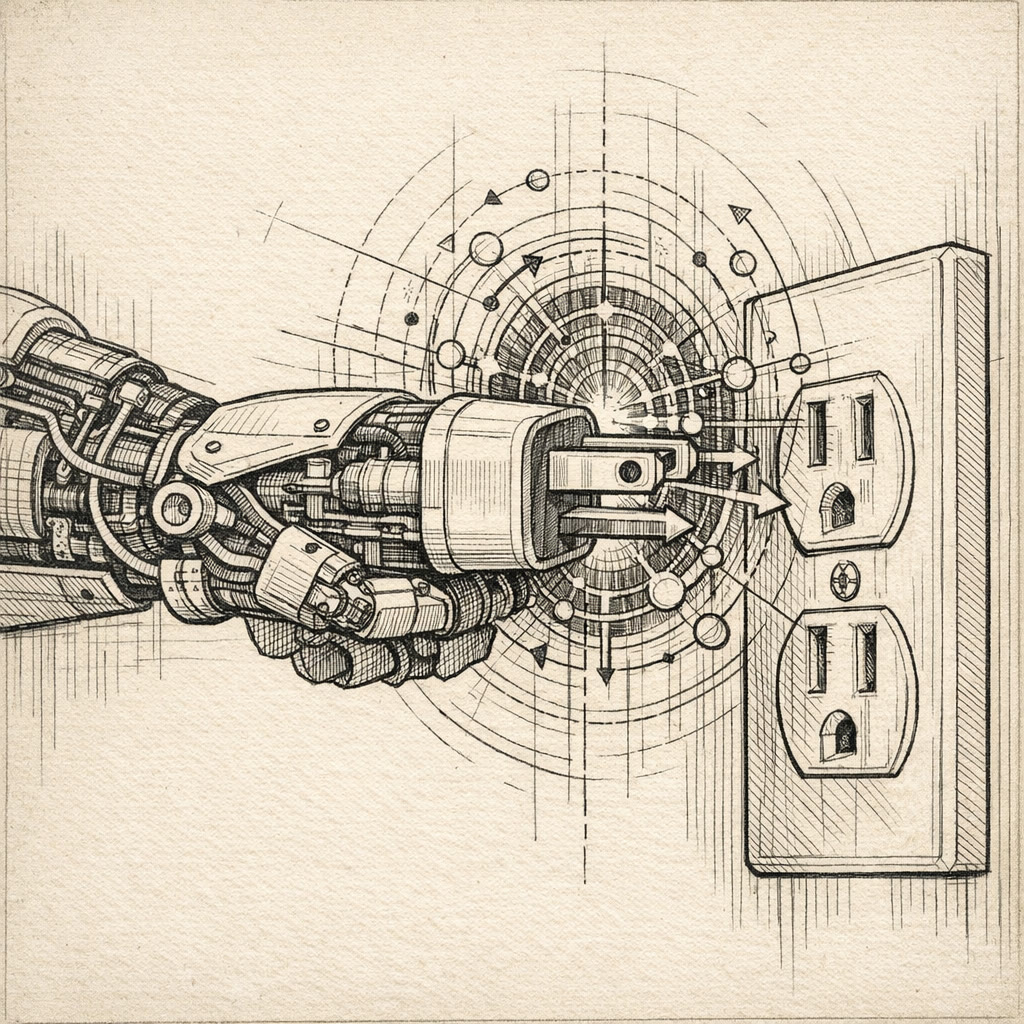
A charger plug has to reach a socket at the right angle, and the attempt usually fails in the moment the two touch. A new robotics paper reports that its largest model helped most in exactly that moment. The model is a vision-language model, a system pretrained to work with images and text, so it learned to read pictures and words long before it was asked to push a plug into anything.
Audio is in English only for this language. Also read aloud in Spanish, French, Italian and Portuguese.
ScaleVLA puts a 552-billion-parameter model in charge of a robot arm and tests it on a charger
In a paper submitted on 16 November 2026 and listed on Hugging Face Papers, Ruixi Yu and 11 co-authors introduce ScaleVLA. It connects a 552B DeepSeek-V4.1-Flash backbone to a trainable action DiT. The backbone is the large pretrained model at the base of the system. A DiT, or diffusion transformer, is a network that builds its output by refining a rough guess over several passes, and here the output is robot motion. Together they form a vision-language-action model, or VLA, meaning a system that takes in camera images and instructions and puts out motor commands. The 552B figure counts parameters, the adjustable numbers a network learns during training.
The authors compared backbones from 2 billion to 552 billion parameters under a shared training setup. Their one real-world task in the abstract is charger insertion, where success improved from 4 in 10 to 9 in 10, "with gains concentrated in contact-sensitive alignment."
The largest real-world gain landed where the plug touches the socket
The authors open with a premise: frontier vision-language models such as GPT-6 Astra have shown strong abilities in robot control, "suggesting that broad pretraining provides knowledge valuable for physical action." Pretraining on images and text would most naturally help a robot recognize objects or follow instructions.
The charger result points somewhere else. Contact-sensitive alignment is the stage where the plug meets the socket and a small misalignment decides whether it goes in. That stage involves no naming of objects and no reading of instructions. Yet the abstract says the improvement clustered there.
Ten trials and an unnamed starting point cannot explain why
The evidence is small. The result is 4 successes against 9, which is a difference of five runs. A few runs going the other way would change the size of that gap. The abstract also does not say which setup produced the 4 in 10, so it is unclear whether the comparison is against a smaller backbone from the paper's own lineup or some other starting point. It does not say why the gains gathered at contact either.
The usual case for bigger models makes the result harder to place. That case is usually framed around broad knowledge of the world. In the post announcing its Edge0-145B laptop model, Edge0 notes that Apple acknowledged its roughly 3-billion-parameter on-device model "was not designed for agentic applications requiring general world knowledge." ScaleVLA's abstract leans on the same idea of knowledge from broad pretraining. Lining up a plug against a socket is not what people usually mean by world knowledge, and the abstract does not connect the two.
What a model built on images and text brings to the moment a plug meets a socket
The authors conclude that frontier vision-language models can serve as "powerful representational foundations" for robot policies. A representation is the internal way a model encodes what it sees. A policy is the rule that turns what a robot sees into what it does. If that holds, the large models that already write and reason are becoming the base layer for robot hands.
The charger result leaves one question open. When the biggest jump arrives at the instant of contact, what is a model trained largely on pictures and words carrying into that instant that smaller backbones are not?
For now, the record is one paper, one real-world task and nine plugs seated out of ten. Larger trial counts and other tasks that depend on contact are what would show whether this pattern holds.